
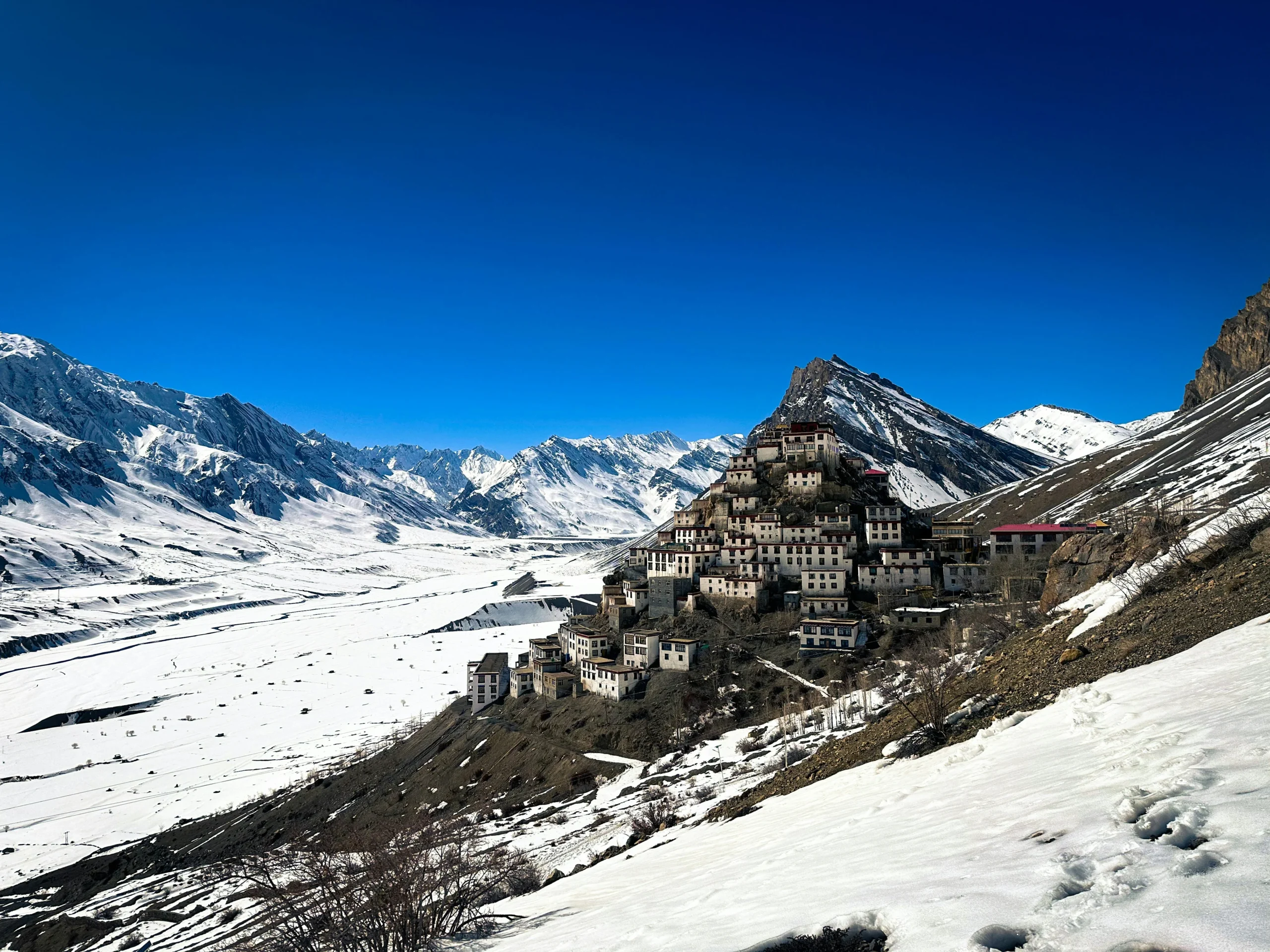
Spiti is also known as the “Middle Land,” as it lies between Tibet and India! It is the most beautiful hill station I have visited, yet. The picturesque landscapes seem like something out of a painting. With monasteries adorning this valley and mountains stretching up to as far as the eye can see, Spiti is a place every Indian would like to visit, once in their lifetime and for good reason!
Located in Himachal Pradesh, Spiti Valley is a cold desert mountain valley that offers surreal views and raw Himalayan beauty.
Below you will find how you can explore Spiti in 10 days, along with routes, bus timings, itinerary, cost-cutting tips, and stay options.
Also, if you are planning to explore Kinnaur along with Spiti, read my detailed guide – Kinnaur Travel Guide

Best Time to Visit Spiti
Spiti looks stunning throughout the year, and each season offers a completely different experience. Ideally, you’d want to visit it more than once to truly witness its changing moods, from spring to deep winter.
If you’re drawn to greenery, blooming wildflowers, and clear skies, the best time to visit is between June and August. The valley comes alive with bursts of colour, and the roads are mostly open, making it easier to explore.
On the other hand, if you’re after the raw, rugged beauty of “Winter Spiti”, the months from December to March are perfect. Expect snow-covered villages, frozen rivers, and the chance to experience Spiti’s remote charm at its most untouched. Be prepared, though — winters in Spiti are harsh, with temperatures often dropping below -20°C, limited homestay availability, and only the Shimla-Reckong Peo-Kaza route remains open (the Manali route stays closed).
Spiti in 10 Days – Itinerary
Note: Women get a 25% discount on local public transport in Himachal Pradesh
Day 1: Delhi to Reckong Peo
To reach Spiti Valley from Delhi, you must reach Kinnaur district in Himachal. I took an overnight HRTC or Himachal Road Transport Corporation bus from Delhi to Chandigarh. It gave me a chance to explore the little corners of Chandigarh until I boarded my bus to Reckong Peo.
From Chandigarh, you can get a deluxe bus that leaves in the evening at 5:50 PM, 6 PM, and 7 PM. Alternatively, you can also take a bus directly from Delhi at 8 PM to Reckong Peo. The price of the direct bus to Reckong Peo is about INR 1000 and takes almost 19 hours to reach.
Once you reach Reckong Peo, there are many things you can do, even in a day.
Planning to explore Reckong Peo? Read our guide here – Kinnaur Travel Guide
Also Read – Chitkul Travel Guide
Day 2: Reckong Peo to Nako
How to Reach Nako from Reckong Peo?
Local Buses
There are two buses that leave from Reckong Peo to Nako – 7:00 AM and 1:00 PM. The best would be to take the 7:00 AM bus, as you will have more time to explore Nako when you arrive and experience the golden hour (sunset).
Also, make sure to buy the tickets as early as possible (preferably the previous day or whenever the counter opens). This is because the travellers who are travelling from Shimla buy tickets while coming from Shimla. And, if you do not buy the tickets in advance, you will be able to board the bus nonetheless, but you will be deprived of a seat for the entire journey of 4 hours.
It takes about four to five hours to reach Nako from Reckong Peo and costs approximately INR 160 per person.
The bus stops only once in between for breakfast for around 20 minutes. There will be many dhabas and restaurants to choose from, and all of them serve decent food.
Shared Cabs/Taxis
If you would prefer to take a taxi, you can opt for a shared taxi, which would be either a Bolero or a Sumo or a similar vehicle, leaving for Nako every morning. It will cost you more than a bus and yet, is a cheaper option, ranging from ₹300 – ₹500 per person. With fewer stops than a bus, the taxi will reach Nako faster. You can board one directly from the Reckong Peo taxi stand, early in the morning.
Other Options
The other option would be to book a private cab, which will cost you around ₹3000 – ₹3,500 or rent a self-drive car or a motorcycle, if you would like to ride by yourself. However, make sure that you are confident enough to drive in these terrains as they are quite prone to landslides.
Where to Stay in Nako?
I stayed at Hotel Zambala, as it gave me a wonderful view of the lake from my room. They have the option to have a bonfire at night, where you can sit beside the lake and enjoy the warmth.
Places to See in Nako
Nako is a part of Kinnaur district; however, since the village lies in a sensitive restricted region that lies along the Tibet border, it is one of the lesser-explored places. Also, only BSNL works here, and I would suggest you download offline maps along with the necessary information, as internet connectivity is quite unreliable.
- Nako Lake: Nako is a holy lake, and when the water is still, you can get a reflection of the village. Go to the left of the lake and climb the stairs, following the path adorned with Tibetan flags at a height, to see the panoramic view of the entire village as well as a beautiful sunset.
- Monastery: Founded by Ringchen Zangpo in 996 AD, it is believed by the villagers of Nako that the monastery was built in the 11th century, along with 108 other monasteries that stretch from Nako to Ladakh, and all of them were built in one fortnight.
Bonus: Hidden Gems
I did not explore these places due to a lack of time, but if you have some, do explore these least-explored places:
- Nako to Tashigang: The walk to this place is about four hours to this village, which you can reach through Nako Pass.
- Tashigang to Somang Trek: You have to walk for two hours to reach Somang, which has caves and a monastery. It is a hidden land with stories saying that the place is visited by fairies, and that immortal people live here. The trek to Somang requires at least two days, as it is an important Buddhist pilgrimage site believed to be the place where Guru Padmasambhava meditated in the caves around Somang Monastery.

Day 3: Nako to Tabo
How to Reach Tabo from Nako?
Local buses
There are two buses which leave from Nako, each with its own perks.
- Between 11:30 AM – 12:30 PM – The bus comes straight from Reckong Peo, allowing you to reach Tabo by around 4 PM. This gives you enough time to explore the beautiful village of Tabo. However, you might not find any seats in it, which I think is okay because the bus journey is just about two hours, which is manageable.
- 2 PM – The downside of this bus ride is that it will arrive later in the evening, giving you less time to explore. But the brownie point for this bus is that you will be able to get a bus seat easily!
It will take approximately 2 to 2.5 hours through the beautiful valley of Spiti, where you can see the steep valley below along with the gorgeous Spiti River running amidst it. The fare is about INR 80 per person.
The bus stops once in between for lunch for around 20 minutes, where you can drink tea and chill for a while. Also, the BSNL signal is available at this place.
Other Options:
The other options are to hitchhike, take a shared cab/taxi or hire a private cab. A private cab would, of course, cost you the most but give you more flexibility. Alternatively, you can also rent a self-driving car or a motorcycle.
Where to Stay in Tabo?
I stayed in a common room of the monastery. Not only is it cheap, but very serene and peaceful, too. The bathrooms aren’t attached to the room, but there is a common washroom just next to the rooms. Furthermore, when I visited the place, the monastery was undergoing construction of its library, as well as building better rooms for the tourists.
Places to See in Tabo
Tabo is the oldest continuously functioning Buddha monastery in India, established in 996 A.D. The renovation inscription says that it was founded by the “Bodhisatva” and was renovated again 46 years later.
In the 1970s, the monastery faced deterioration, prompting efforts for its revival. Two monks, Geshe Yeshe Chhodan and Geshe Sonam Wangdui, played pivotal roles in restoring the monastery’s heritage
Kalchakra Stupa: This unique stupa’s symbolism is not connected to Buddhism. Instead, it is a symbol of the Kalachakra Tantra, created to protect against negative energies.
Meditation Caves: Previously, the caves located here were used as assembly halls as well as dwellings during the winters. Even today, some of the caves are used for meditation, indicated by flags hung outside when somebody is meditating inside. To reach the caves, you have to climb up a few stairs for about 10 minutes.
Oldest Monastery: Protected by the Archaeological Survey of India (ASI), the monastery was destroyed by the earthquake of 1975 and later revived by the two monks. It is here that the 14th Dalai Lama held the Kalachakra ceremonies twice.
If you want to know how to have a fruitful solo experience on travels, read a few tips here – Solo travel tips in Sikkim
Day 4: Tabo to Sichling Village to Dhankar Village
How to Reach Sichling Village and Dhankar Village from Tabo?
Local buses
Next morning, take a 9 AM bus to Sichling Village. From here, you can either hitchhike to Dhankar or hire a taxi. I was lucky enough to find a vehicle to hitchhike. The bus takes about an hour to reach Sichling Village and costs approximately INR 30.
There are many interesting things about this place:
- In old times, Dhankar served as the capital of Spiti. The hike from Sichling to Dhankar is about 8 km and can be done on foot if you’re up for it.
- Once upon a time, there was a fort here, but now only remnants remain, including a large house atop the hill.
- From Dhankar, you can reach Kaza directly without returning to Sichling, thanks to a motorable road of approximately 28 km amidst the mountains.
- The road from Dhankar to Kaza is in decent condition and takes approximately 30–45 minutes by vehicle.
- The place is rich with history. I was told there was a Raja here who resided with his sons; however, he sold his cultivated lands to the villagers, and his sons moved to Kaza.
Where to Stay in Dhankar Village?
You will find many homestays near the monastery which charge INR 800 – INR 1500 per room, depending on the season you are planning to go.
There are two monasteries in Dhankar – the Old and the New. The New one is situated right at the entrance of the village and has an option for accommodation.
Places to See in Dhankar Village
- Dhankar Gompa: The complex is built on a 300-metre-high spur overlooking the Spiti and Pin Rivers – one of the world’s most spectacular settings for a gompa. However, it is also one of the 100 most endangered sites in the world.
- Dhankar Lake: At an altitude of 4,140 meters, Dhankar Lake is a hidden gem lying amidst the tall mountains where you can see tall, white mountain peaks in the distance. It is prohibited to camp here as the lake is considered holy and a livelihood for the people of the Dhankar Village for their farming and agricultural activities.

Day 5: Dhankar Village to Kaza
Trek down to Sichling from Dhankar village, which will take you about an hour to an hour and a half. It is just 8 kms away, and if you manage to hitchhike with someone, or have your own vehicle, there is nothing like it!
You can also hitchhike again from here or hire a cab, or catch a bus to Kaza. Waiting for a bus is not an issue at all. There are cafes where you can relax, drink tea and wait for the bus.
How to Reach Kaza?
Local buses
There are two buses which depart from Sichling Village towards Kaza. The bus in the morning departs at 10 AM, and there are good chances of you securing a seat. Another bus passes through Sichling at 5 PM, originating from Reckong Peo, and there are fewer chances of getting a seat there. The journey takes about 1.5 to 2 hours, and tickets are typically quite cheap.
Where to stay in Kaza?
Since Kaza is the capital of Spiti, it is relatively easy to get decent accommodation here. Moreover, it is quite populated for you to have access to WiFi, marketplaces, cafes, etc. You can rent vehicles here to roam around, too.
Winter White is one of the best places to stay in Kaza. Not only do they have free WiFi, but the staff here is really friendly, and they have an in-house restaurant which serves mouth-watering delicacies.
Places to see in Kaza
You can stay in Kaza while you explore the various places in the Spiti Valley. Alternatively, you can also explore the village while you leave for the other nearby places the next day.
Day 6: Kaza to Kibber to Chicham Bridge to Key Monastery
How to Reach Kibber from Kaza?
You can rent a two-wheeler or a self-driving car to travel to these places from Kaza. The roads are quite smooth and well-built. I rented a bike at INR 700 per day. Alternatively, you can also take a bus. You’d have to talk to the locals in advance, as the bus timing changes according to the seasons.
When I was travelling in Spiti, a bus would leave for Kibber from Kaza at 4:30 PM. You pass the Key Monastery and the Key village on the way. Buses are quite cheap here, with ticket prices being about INR 30.
Kibber
Kibber is a cold desert in the Spiti valley with breathtaking, green meadows, famous for its snow leopards.
When you enter Kibber, the welcome sign notes, “Welcome to Kibber Wildlife Sanctuary”, which means that the village is situated in the sanctuary. Quite cool, isn’t it?
If you plan to explore this place in the winter, there are sure-shot chances of seeing the Snow Leopard, along with other wild animals such as ibex, blue sheep, etc.
Chicham Bridge
Explore Asia’s highest man-made suspension bridge between the Chicham and Kibber Village, overlooking a dramatic gorge. During the early days, villagers used to trek all the way down to the valley and back. There is hardly any difference between Kibber village and Chicham village. You can easily walk to the Chicham bridge from Kibber.
For the best views, visit early in the morning or in the late afternoon.
Key Gompa
Key Monastery is one of the most mesmerising sites I have seen in my life. So much so that it brought me to tears and gave me goosebumps. Perched dramatically on a hilltop, the Key Gompa is the most iconic site of Spiti, and still an active monastery.
This monastery has gone through a lot, having been destroyed in wars and then destroyed by an earthquake. However, the Archaeological Survey of India revived the heritage to what it looks like right now.
How to Reach Key from Kibber?
I trekked down from Kibber Village to Key Gompa, which took approximately an hour and a half. There is only one bus that leaves from Kaza for Kibber at 4:30 PM, and then the bus leaves early in the morning from Kibber for Kaza at 8:30 AM. However, make sure that you ask around before, as the bus timing may vary over the years and as on the season.
So, for me, the most sensible option was to walk or hitchhike. But hey, if you have a bike, you do not have to worry.
Where to Stay?
You can stay in the monastery for just INR 250, and in this minimal amount, they serve you food (lunch, dinner, and breakfast), along with tea. What better way to explore Spiti than to live with the monks and experience their lifestyle?
Bonus Tip: Trek a little from Key Gompa to see an aerial view of the valley. It takes an hour to trek, but even if you trek for just 10 minutes, the view becomes equally mesmerising. Ask the monks at the trekking start point for the aerial view, and they will guide you.

Day 7: Kee to Kaza to Pin Valley to Langza
How to Reach Pin Valley, Langza, Hikkim and Komic from Key Gompa?
Take a bus at 8:30 AM from Key to Kaza, and then hop on a bus to Pin Valley. However, there are no buses from Pin to Langza.
However, I would highly recommend renting a two-wheeler for this, so you to easily explore the nooks and corners of Pin Valley. You can continue your journey to Langza, Hikkim and Komic.
Pin Valley
With approximately 17 villages and only 1500-1600 people, it is one of the most beautiful valleys that I have been to. Somehow, I felt colder here as compared to the rest of the places in the Spiti district. The last village is Mudh, which is 36 KMs from Kaza.
Langza
Langza, the fossil valley, is so unique that you can find fossils of sails in tons here. Millions of years ago, this entire region was submerged under the Tethys Sea. When the Himalayas rose, the seabed turned into fossil-rich soil. Even today, locals often find ammonite fossils and some even sell them as souvenirs (though technically, fossil collection is restricted).
I recommend coming here from Pin, as you won’t find accommodations easily in Pin. Moreover, you can stargaze and see the Milky Way clearly from Langza, along with the iconic golden Buddha statue.
Where to stay in Langza?
You can find decent homestays in Langza to experience the Spitian life. People here are quite friendly.


Day 8: Langza to Komic to Hikkim to Kaza
Early in the morning, leave for Komic. The route is really rugged and bumpy.
Komic
Komic is famously known as the world’s highest motorable village. Due to its high altitude, the weather conditions here are extreme and harsher than those in other areas in Spiti. Hence, my suggestion would be to pack appropriately. Further, accommodation is limited here with only a handful of homestays.
Do not miss out on visiting the monasteries, and eat at the world’s highest restaurant, which is right next to the monastery.
Hikkim
From Komic, drive down to Hikkim, the village with the highest post office in the world. It is such a surreal feeling to send postcards to your loved ones from here. There is a cafe right next to the post office, where you can buy postcards. Alternatively, you can get your own postcards. Do not forget to stamp them before sending.
You won’t really find any homestays to stay here. But while you drive down from this village, you will be able to see the aerial view of Kaza, which is a surreal experience.

Day 9: Kaza to Losar to Kunjum Pass to Chandratal Lake
There are buses that run from Kaza to Manali, only in specific months, which is typically during the summer from June to September, depending on when Kunzun Pass and Rohtang Pass open and close for the season.
How to Reach?
Local Busses
During the season, HRTC buses commute in the morning from 6:00 AM to 7:00 AM. However, make sure that you check with the locals the previous day, as the bus schedule is quite sketchy, depending on the season and the road conditions.
Alternatively, you can also opt for shared taxis or a tempo traveller, which you can book near the Kaza bus stand.
Get down at Batal and hitchhike on a jeep or dozer till Battal dhaba. You can also trek until Batal, but what better way than to hitchhike and reach a little faster?
Alternatively, you can get down at Losar, and from there you can rent a two-wheeler, which costs approximately INR 800 – INR 1000.
You can easily return to Losar by evening and stay the night in Losar.
Where to Stay?
Camping near the lake is not possible anymore due to a sudden jump in the number of tourists. I will suggest you come down to Losar the same day and stay at Kit Khang Homestay. The family is very nice, and their hospitality is commendable. Similarly, you can choose any other homestay which is convenient for you.
Places to Visit in Losar
Visit the iconic Chandra Tal Lake from Losar, one of the crown jewels of the Spiti Valley. Keep in mind that this lake is accessible only during the summer months. The emerald green water here will heal your soul.
The lake gets its name from its shape, which resembles a crescent moon. With the changing direction of the sun rays, the lake changes its colour, too.

Day 10: Losar to Manali to Delhi
From Losar, hop on a bus to Manali, which typically departs from Kaza. Usually, the buses in the morning depart around 6 AM – 7 AM. It will take you directly to Manali via the beautiful Rohtang Pass.
From Manali, you can get buses, shared cabs or private cabs to Delhi. From ordinary buses to Volvo, the cost varies from INR 700/- to INR 1500/-, depending on your budget and comfort.
If you want a detailed guide on Chitkul and Sangla, you can read our guide here – Chitkul Travel Guide
The Route I Followed – Map
Below is the complete circuit that I was talking about above.
If you want to know how you should pack for Spiti, read my guide here.
You can see my camping essentials over here.
Network Connectivity in Spiti
BSNL works the best in Spiti Valley. Airtel and Jio have some amount of coverage in Kaza, but it is not reliable. BSNL is practically the only network which works well here. However, do not expect high-speed data.
You can buy a BSNL SIM (prepaid or postpaid) in Himachal Pradesh. I would suggest you get a prepaid SIM.
ATMs, Petrol Pumps and Road Conditions
ATMs and Petrol Pumps are available only in Kaza. In other villages, these facilities are not present. So, it is wise to withdraw sufficient cash and fill your tanks in Kinnaur’s Reckong Peo, which is the last major town before you enter Spiti.
Also, note that ATMs in Kaza are often out of cash or not functional, especially during peak tourist season or after heavy snowfall.
The roads to Spiti are in surprisingly decent condition considering the remoteness, especially the stretch from Reckong Peo to Kaza via Nako. So, driving here is a good experience.
However, during heavy snowfall or rainfall, the roads get blocked due to snow accumulation or landslides. Ensure that you check the weather and road conditions once you reach Reckong Peo.
I was very excited to write this blog. Spiti is one of my favourite places, and I am sure it will be yours too. Let me know if this blog helped you in the comments below, and ask any queries. I love answering questions